
Counter-UAS & Spectrum
Spectrum Monitoring Vehicle
4x4 mobile spectrum monitoring and direction finding station covering 1 MHz to 8 GHz for monitoring and 20 MHz to 8 GHz for…
Overview
4x4 mobile spectrum monitoring and direction finding station covering 1 MHz to 8 GHz for monitoring and 20 MHz to 8 GHz for DF, with 80 MHz real-time IF bandwidth, 100 GHz/s scanning and single-burst DF in under 5 ms. Single-channel monitoring and dual-channel direction finding run simultaneously; total equipment consumption is under 400 W.
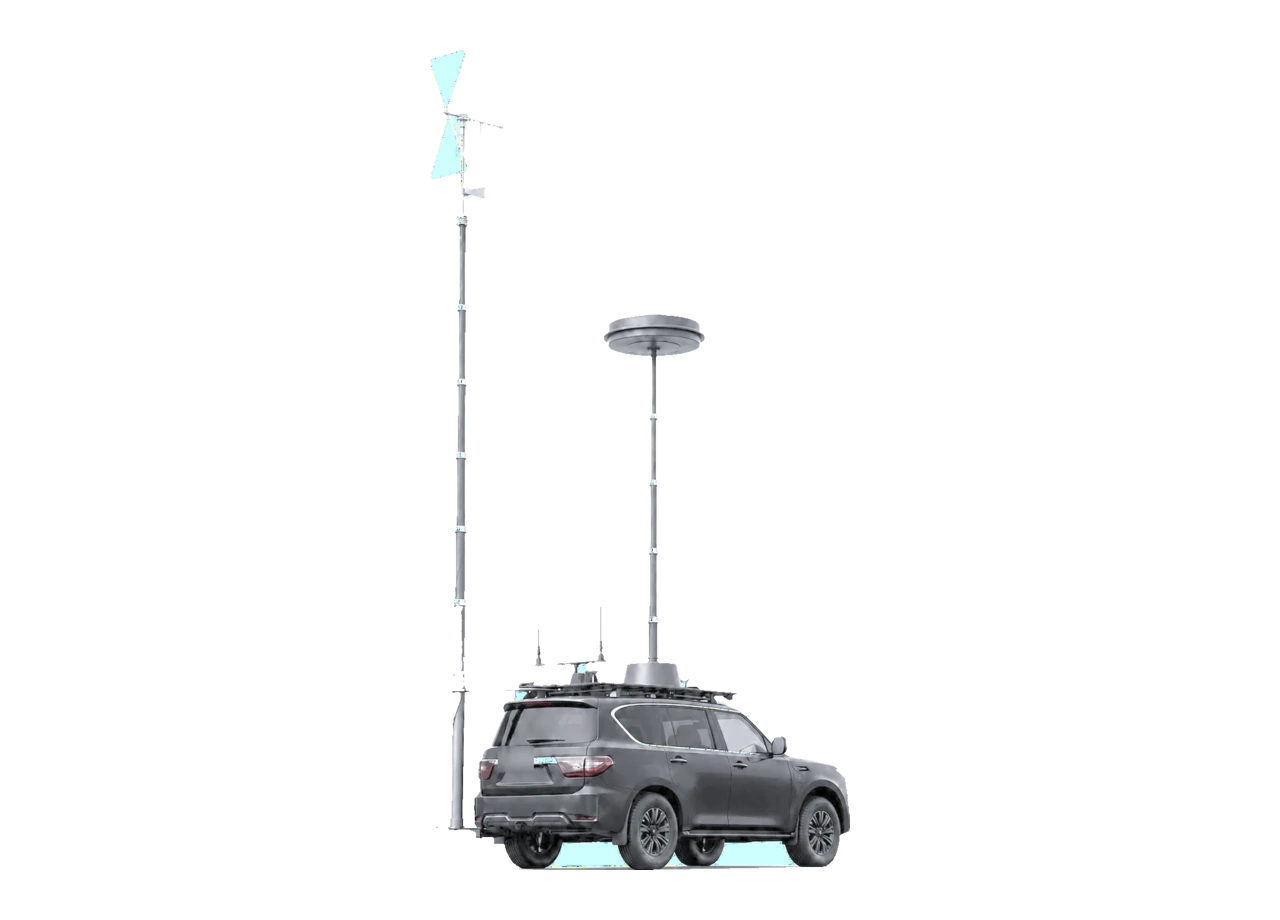
The Spectrum Vehicle equips a 4x4 SUV with a complete spectrum monitoring and direction finding suite - a VHF monitoring antenna, an HF monitoring antenna and a direction finding antenna, each with its own receiver, plus application software and an integrated power supply. Two operator positions with rugged displays sit in the rear cabin, and a VHF radio can be fitted as an option for communications.
Monitoring covers the HF, VHF, UHF and SHF bands; single channel monitoring and dual channel direction finding work simultaneously, and the system supports monitoring and analysis of various analog device signals. The direction finding algorithm is optimised using a mean clustering algorithm with strong resistance to multipath interference.
Signal interception can generate spectrum templates so that unknown or sudden abnormal signals are identified automatically. The equipment has strong electromagnetic anti-interference ability and is not prone to generating false signals, and total power consumption of the entire equipment is 400 W or less.
Put a full monitoring and direction finding capability on wheels so that unknown emitters can be found, characterised and geolocated wherever they appear.
Technical · 12 parameters
Specifications
Key features
- Wide monitoring coverage — Monitoring frequency covering the HF/VHF/UHF/SHF frequency bands.
- Simultaneous monitoring and DF — Single channel monitoring and dual channel direction finding work simultaneously.
- Analog signal analysis — Supports monitoring and analysis of various analog device signals.
- Multipath-resistant DF — Direction finding algorithm optimised using a mean clustering algorithm, with strong resistance to multipath interference.
- Low power consumption — Power consumption of the entire equipment is <=400 W.
- Signal interception — Can generate spectrum templates and automatically identify unknown signals or sudden abnormal signals.
- Electromagnetic compatibility — Strong electromagnetic anti-interference ability, not prone to generating false signals.
Where it operates
- Mobile spectrum survey — Monitoring across HF/VHF/UHF/SHF while on the move or from a static position.
- Emitter geolocation — Dual-channel direction finding running simultaneously with single-channel monitoring.
- Anomaly detection — Spectrum templates automatically flag unknown signals or sudden abnormal signals.
- Burst signal DF — Instantaneous direction finding of single burst signals within 5 ms.