
Counter-UAS & Spectrum
Counter-UAS Command Shelter
Self-contained counter-drone command and control shelter integrating omnidirectional RF detection, low-altitude surveillance…
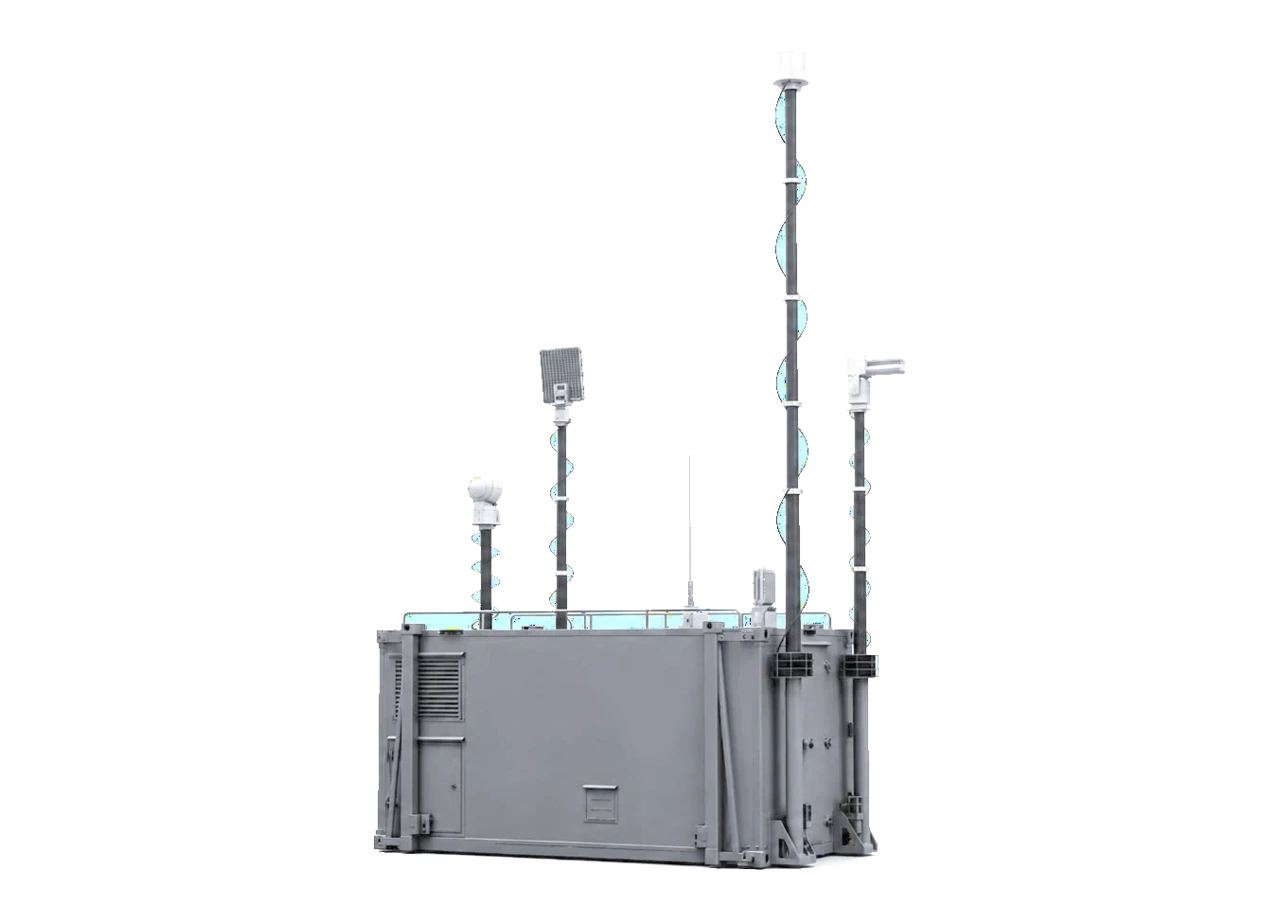
Overview
Self-contained counter-drone command and control shelter integrating omnidirectional RF detection, low-altitude surveillance radar, directional jamming and GNSS decoy on electric lifting masts, with a GIS-based command console inside a 40 dB shielded cabin. Radar detection to 5 km (RCS 0.01 m2), spectrum detection to 15 km against 30 simultaneous targets, jamming 70 MHz - 6 GHz out to 5 km, response time under 4 seconds.
The Anti-Drone Command and Control Shelter integrates radio detection, radar detection, spectrum jamming and navigation decoy technology so that response time is less than 4 seconds, achieving "jamming upon discovery" of UAV targets. Strong information processing acquires and processes UAV target information in real time and displays the whole process of detection, identification, tracking and attacking on a map background, so the engagement is fully visible.
Interference is full-band software defined - 70 MHz to 6 GHz SDR broadband write-frequency interference counters more than 98% of civil and customized band UAV communication links with high strike reliability. The system supports radio detection of 30 drones at the same time and the radar can detect and track more than 100 targets at the same time, effectively dealing with the harassment of UAV swarms.
Radar, spectrum detection and spectrum jamming antennas are installed on automatic lifting rods for greater demanding field effectiveness; the system is EMC designed and uses a selected 40 dB shelter. The demanding field flow runs information convergence, multi-station convergence, situational awareness and threat assessment into a command control centre - target detection information (drone positioning, drone direction finding, track tracking, pilot positioning) feeds detection / early warning, then targeting, then countermeasure handling (expulsion, forced landing) via automated countermeasure commands.
The shelter is engineered as a complete platform - man-machine-environment engineering design (noise reduction, operational space, cabinet operation, ventilation, switching operation, boarding and power wall box operation analyses), environmental adaptability design (temperature, vibration shock, rain, mould/salt spray, solar radiation, anti-sand and dust) and electromagnetic compatibility work (radiation characteristics simulation, cable crosstalk analysis, shelter shielding treatment, antenna direction pattern and antenna isolation).
Give a fixed or relocatable site a single shelter that detects, identifies, tracks and defeats small drones autonomously, while serving as the manned command post for the engagement.
Technical · 22 parameters
Specifications
Key features
- Integrated detection & jamming
- Fully visible
- Full band software defined interference
- Batch target tracking — Radio detection of 30 drones simultaneously; radar detects and tracks more than 100 targets simultaneously.
- System integration — Radar, spectrum detection and jamming antennas on automatic lifting rods; EMC designed; 40 dB shelter.
Where it operates
- Detection and early warning — Drone positioning, drone direction finding, track tracking and pilot positioning feed a common picture.
- Automatic jamming upon discovery — Detection to countermeasure in under 4 seconds using full-band SDR interference.
- Expulsion or forced landing — Countermeasure handling drives the target away or forces it down.
- Multi-station command — Multi-station convergence and threat assessment across several anti-drone stations.
- GNSS denial / spoofing — GPS defense system blocks and spoofs satellite navigation of intruding drones.